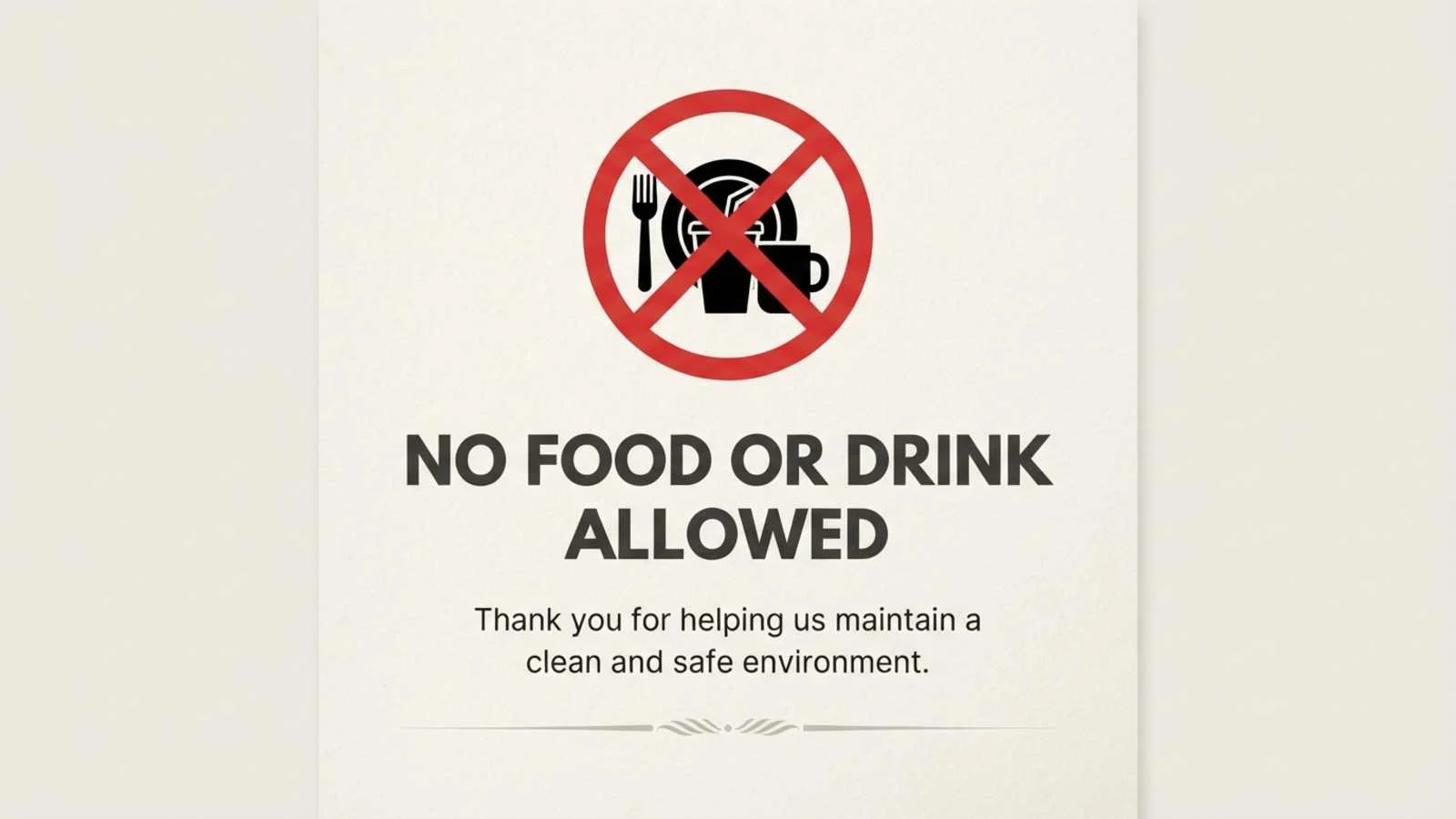
“No food or drinks” means food and beverages are not allowed in a specific area. It is a common sign in schools, libraries, offices and museums. It is grammatically correct as a shortened sign phrase (not a full sentence). “No food or drink” means the same thing and is also correct.
Have you ever seen a sign that says “No Food or Drinks” and wondered what it means?
You may find this sign in schools, libraries, offices, museums, hospitals, and other public places.
It is a simple message, but it plays an important role in keeping shared spaces clean and safe.
People often search for “no food or drinks” to understand its meaning, check whether it is grammatically correct, or learn how to use it in a sentence.
Some may also wonder whether they should write “No Food or Drink” instead. Both forms can be correct, but the best choice depends on the context.
The phrase tells people that they must not bring, eat, or consume food and beverages in a specific area. However, the exact rule may vary from place to place.
For example, a library may ban all food and drinks, while a meeting room may allow water but not other beverages.
In this guide, you will learn the meaning, grammar, origin, and correct use of “no food or drinks.” You will also find useful examples, common mistakes, and answers to frequently asked questions.
No Food or Drinks – Quick Answer
“No food or drinks” is a common sign phrase that means eating food and consuming beverages are not allowed in a particular area.
It is often used on doors, walls, tables, and public notices.
Examples:
- Library: No food or drinks are allowed inside.
- Classroom: Please follow the no food or drinks rule.
- Museum: No food or drinks beyond this point.
- Office: No food or drinks near the computer equipment.
The phrase is short and easy to understand. It is suitable for signs because it tells people what they cannot do without using a long sentence.
Is “No Food or Drinks” Grammatically Correct?
Yes. It is grammatically acceptable as a sign or notice. It is a shortened phrase rather than a complete sentence.
For a full sentence, you could write:
- Food and drinks are not allowed here.
- Please do not bring food or drinks into this room.
- Eating and drinking are prohibited in this area.
“No Food or Drink” is also correct and is often used on formal signs.
The Origin of “No Food or Drinks”
The phrase “no food or drinks” developed from the common use of short warnings and rules in public places. It does not have one known creator or a single recorded starting date.
The word “no” expresses denial or prohibition.
The word “food” refers to things people eat, while “drinks” refers to liquids that people consume.
The word “food” has roots in Old English, where related forms referred to nourishment or something used to feed people. “Drink” also comes from Old English and has long referred to consuming liquid or to a beverage itself.
Over time, short phrases became common on signs because they are easy to read quickly. A sign such as “No Food or Drinks” communicates a rule in only four words.
Why Are There Different Versions?
You may see these variations:
- No food or drinks
- No food or drink
- No eating or drinking
- Food and drinks prohibited
These forms express similar ideas but differ in style and structure. “No food or drinks” names the prohibited items. “No eating or drinking” focuses on the actions that are not allowed. “Food and drinks prohibited” uses a more formal tone.
British English vs American English Spelling
The phrase “no food or drinks” uses the same standard spelling in British English and American English. There is no major regional spelling difference between these versions.
The words “food” and “drink” are spelled the same in both varieties of English. The main differences you may notice relate to style, punctuation, and the wording of signs rather than spelling.
| Phrase | British English | American English |
| No food or drinks | Correct | Correct |
| No food or drink | Correct | Correct |
| No eating or drinking | Correct | Correct |
| Food and drinks prohibited | Correct | Correct |
| No food & beverages | Possible, but less natural | Possible, but less natural |
Which Version Is More Common on Signs?
Both British and American English speakers can understand “No Food or Drinks.” The singular form, “No Food or Drink,” is also common in formal notices.
The choice often depends on the organization, the intended tone, and local writing conventions. There is no universal rule that requires British signs to use one version and American signs to use the other.
For clear communication, choose one phrase and use it consistently throughout your building, website, or printed materials.
Which Spelling Should You Use?
Since “no food or drinks” has no major British-American spelling difference, your choice should focus on the audience and the purpose of the notice.
For American Readers
Use “No Food or Drinks” when you want a clear and familiar sign. It works well in schools, offices, libraries, and public buildings.
Example: “No food or drinks are permitted in the computer lab.”
For British Readers
You can use “No Food or Drink” or “No Food or Drinks.” Both are understandable. For a formal sign, “No Food or Drink” is a suitable option.
Example: “No food or drink is permitted in the examination hall.”
For a Global Audience
Choose simple wording that readers from different countries can understand. “No Food or Drinks Allowed” is a clear option for international schools, hotels, museums, and workplaces.
If the rule has exceptions, state them clearly. For example, “No food or drinks, except bottled water.”
Common Mistakes with “No Food or Drinks”
People sometimes use this phrase incorrectly or make signs that are unclear. Here are common mistakes and their corrections.
1. Using Unclear Wording
Incorrect or unclear: “No.”
Better: “No food or drinks allowed.”
The second version clearly communicates a prohibition.
2. Treating Every Sign as a Full Sentence
“No Food or Drinks” is acceptable as a short sign. It does not need a subject and verb.
For formal writing, use a complete sentence when needed.
Example: “Food and drinks are not allowed in this room.”
3. Confusing “Drink” with “Drinks”
Both forms can be correct.
- “No food or drink” is a common general prohibition.
- “No food or drinks” is also widely used to refer to items and beverages.
Choose the form that best suits your sign or sentence.
4. Using “No Foods or Drinks” Without a Reason
“Foods” can refer to different types or categories of food, but it is not usually needed for a general sign.
Better: “No food or drinks.”
5. Forgetting Important Exceptions
A sign that says “No food or drinks” may be too broad if water or medical drinks are allowed.
Better: “No food or drinks, except water.”
Always make exceptions clear to avoid confusion.
“No Food or Drinks” in Everyday Examples
The phrase appears in many everyday situations. Here are examples of how to use it naturally.
In Emails
“Please remember that no food or drinks are allowed in the computer room.”
This wording is polite and clear. It works well in workplace messages and school emails.
In News and Public Notices
“The museum has introduced a no-food-or-drinks policy in its exhibition rooms.”
This sentence explains a rule in a formal and informative way.
On Social Media
“Reminder: No food or drinks in the study area. Please help us keep it clean!”
This short message is suitable for a school, library, or community page.
In Formal Writing
“Visitors must follow the no-food-or-drinks policy while inside the laboratory.”
This wording is useful in official documents, workplace rules, and visitor guidelines.
On Signs
- No food or drinks allowed.
- No food or drink beyond this point.
- Please do not eat or drink in this area.
- Food and beverages are prohibited.
All these options communicate a similar rule. The best choice depends on the setting and the level of formality.
“No Food or Drinks” – Google Trends & Usage Data
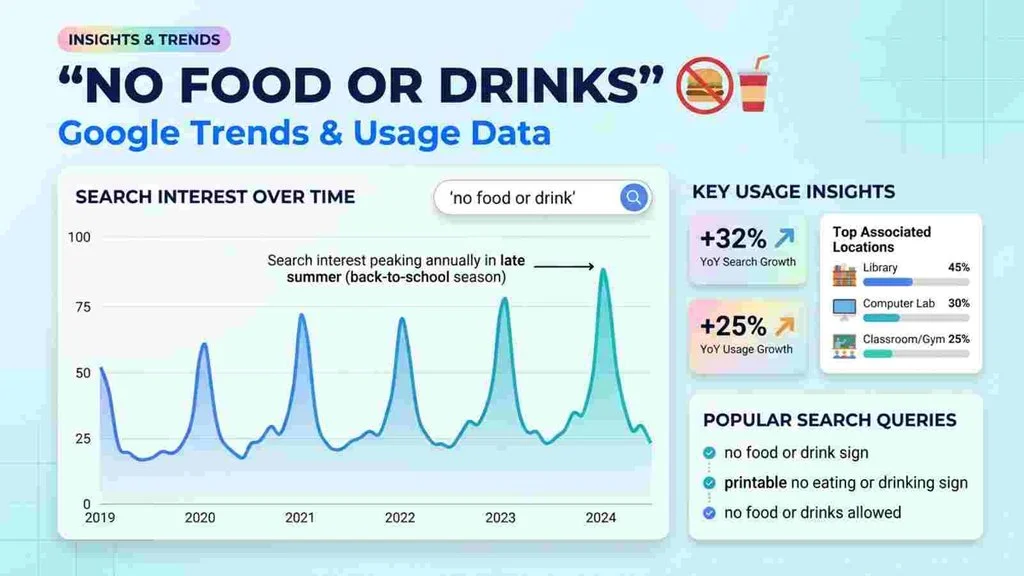
People may search for “no food or drinks” when they need to understand a sign, write a notice, check grammar, or create rules for a public space.
The phrase is useful in several settings:
- Education: Schools, colleges, libraries, and examination halls.
- Workplaces: Offices, laboratories, and computer rooms.
- Public spaces: Museums, galleries, and public transport facilities.
- Events: Conferences, theaters, and meeting rooms.
- Property management: Rental buildings, shared rooms, and private facilities.
Is the Phrase Popular in the United States and the United Kingdom?
The phrase is understandable in both countries because its words have the same spelling and meaning. However, the popularity of this exact search phrase may change by country and over time.
Google Trends can help compare search interest for “no food or drinks,” “no food or drink,” and related terms. It reports relative search interest rather than the total number of searches. A Trends score of 100 represents the highest relative interest for the selected comparison and time range.
Without a live comparison of the terms, it would not be accurate to claim that one country searches for the phrase more often than another.
For clear writing, focus on the meaning, correct grammar, examples, and related phrases. These details answer the likely needs of readers searching for the term.
Comparison Table: “No Food or Drinks” and Similar Phrases
| Phrase | Meaning | Best Use |
| No food or drinks | Food and beverages are not allowed | General signs |
| No food or drink | Food and drink are prohibited | Formal notices |
| No eating or drinking | The actions of eating and drinking are prohibited | Schools and workplaces |
| No outside food or drinks | Items brought from outside are not allowed | Restaurants and event venues |
| Food and beverages prohibited | A formal ban on food and beverages | Official notices |
| Please do not eat or drink here | A polite request | Shared public spaces |
| No food or drinks allowed | A direct and clear rule | Signs and announcements |
The phrases are similar, but they are not always interchangeable. For example, “No outside food or drinks” may allow people to buy food inside the venue. “No food or drinks” usually sounds broader.
Frequently Asked Questions
1. What does “no food or drinks” mean?
It means that people must not bring, eat, or consume food and beverages in the area covered by the rule. The exact restrictions depend on the location.
2. Is “no food or drinks” grammatically correct?
Yes. It is a common and acceptable phrase for signs and notices. It is a shortened expression rather than a complete sentence.
3. Is “no food or drink” better than “no food or drinks”?
Neither version is always better. Both are correct. “No food or drink” is often used in formal notices, while “No food or drinks” is also common in everyday signs.
4. Should “no food or drinks” be capitalized?
Use title case if it is the chosen style for your sign: “No Food or Drinks.” In ordinary sentences, use lowercase unless the phrase begins a sentence or appears in a title.
5. Is there a difference between British and American English?
There is no major spelling difference. Both British and American readers understand “no food or drinks” and “no food or drink.”
6. Can I write “no food and drinks”?
It may be understood, but “No food or drinks” is a more familiar way to express a general prohibition. For a complete sentence, write “Food and drinks are not allowed.”
7. How can I write a polite no-food-or-drinks sign?
You can write, “Please do not bring food or drinks into this area.” Another option is, “To keep this space clean, food and drinks are not permitted.”
8. Where are “no food or drinks” signs used?
In schools, libraries, offices, museums, hospitals, laboratories and other public places where food and drinks could cause mess, damage or safety problems.
9. Can I bring water where “no food or drinks” is posted?
It depends on the sign. Some places allow bottled water even when other food and drinks are banned. Check the sign for exceptions — if it says “No food or drinks, except water,” bottled water is fine.
10. Is “no foods or drinks” correct?
Usually not. “Food” is normally uncountable, so “No food or drinks” is the standard sign wording. “Foods” is used only when talking about different types or categories of food.
Conclusion
“No Food or Drinks” is a simple and useful phrase that tells people food and beverages are not allowed in a specific place.
You may see it in schools, libraries, offices, museums, laboratories, and other public spaces. Its short wording makes it easy to read and understand.
Both “No Food or Drinks” and “No Food or Drink” are correct. The phrase does not have a major spelling difference between British and American English. Your choice should depend on the audience, the setting, and the tone of the notice.
For a general sign, “No Food or Drinks Allowed” is a clear and direct option. For formal documents, you can use a complete sentence such as “Food and drinks are not permitted in this area.” If water or other items are allowed, state those exceptions clearly.
When writing this phrase for a website or public notice, focus on simple words, correct grammar, and a clear message.
This will help readers understand the rule without confusion. In short, choose the wording that fits your audience and makes the restriction easy to follow.

Here’s a concise 2-line author bio suitable for Simifind.com:
James Dashner is an American bestselling author best known for The Maze Runner series and other popular young-adult fiction.
On Simifind.com, he shares clear, engaging insights and helpful content for readers interested in books, writing, and popular literature.







