
Both autumn and fall are correct and mean the same season (the season between summer and winter). Autumn is the usual word in British English; fall is the usual word in American English.
Have you ever wondered whether to say autumn or fall when talking about the season between summer and winter?
Both words describe the same season. Yet, people in different countries often choose one word over the other.
This can cause confusion when you write an email, read a book, or speak with someone from another country. You may wonder if one word is more correct, more formal, or better for school and work.
The good news is that autumn and fall are both correct English words. The main difference is how people use them in different places.
In the United States, fall is more common in everyday speech. In the United Kingdom, autumn is the usual choice.
Both words refer to the season when the weather gets cooler, leaves change color, and many trees lose their leaves. The season comes after summer and before winter.
In this guide, you will learn the meaning, history, and use of autumn and fall. You will also see examples, common mistakes, and tips to help you choose the right word for your readers.
Autumn or Fall – Quick Answer
Autumn and fall mean the same thing. Both words name the season between summer and winter. Neither word is wrong.
The best choice depends on your audience and the type of English you use.
- Autumn: More common in British English and often used in formal writing.
- Fall: More common in American English and widely used in daily speech.
- Both: Correct in most English-speaking countries.
Examples:
- British English: The leaves turn golden in autumn.
- American English: The leaves turn golden in fall.
- General English: We enjoy the cool weather in autumn.
- American conversation: We enjoy the cool weather in the fall.
Notice that American speakers often say “in the fall,” while British speakers often say “in autumn.” Both forms are natural.
The Origin of Autumn and Fall
The words autumn and fall have different histories. Over time, both became common names for the same season.
Where Does the Word Autumn Come From?
The word autumn entered English through Old French. Its deeper roots are linked to the Latin word autumnus, which referred to the season.
It became a common English word many centuries ago. Today, it is widely used in British English and in many other parts of the world.
The word often appears in books, poems, school lessons, and formal writing. It can give a sentence a classic or literary feel.
Example: Autumn brings cool days and bright leaves.
Where Does the Word Fall Come From?
The word fall comes from the Old English word feallan, meaning “to fall.” It became linked to the season because leaves fall from trees during this time of year.
The longer phrase fall of the leaf was once used to describe the season. Over time, people shortened it to fall.
The word remained popular in North America, where it became the usual everyday term in the United States.
Example: Fall is a great time to visit the mountains.
Why Are There Two Words for the Same Season?
English has many words that developed in different places. Some words became more common in Britain, while others stayed popular in North America.
This is why people may say autumn in London and fall in New York. The meaning stays the same, even when the preferred word changes.
British English vs American English
The main difference between autumn and fall is regional use, not spelling. Both words are spelled the same way in British and American English.
| Feature | British English | American English |
| Common word | Autumn | Fall |
| Everyday speech | “In autumn” | “In the fall” |
| Formal writing | Autumn | Autumn or fall |
| Weather reports | Usually autumn | Usually fall |
| School activities | Autumn term | Fall semester |
| Seasonal shopping | Autumn clothes | Fall clothes |
| Meaning | Season after summer | Season after summer |
How British Speakers Use Autumn
In the UK, autumn is the standard word for the season. It appears in weather reports, school calendars, news stories, and everyday conversations.
Examples:
- The autumn leaves are beautiful.
- Our school term starts in autumn.
- Autumn weather can change quickly.
British speakers understand fall, but they may use it less often when talking about the season.
How American Speakers Use Fall
In the United States, fall is the common word in daily speech. It also appears in school schedules, sports, travel plans, and seasonal advertising.
Examples:
- The fall semester starts in August.
- We plan to travel this fall.
- Fall colors attract many visitors.
Americans also use autumn, especially in names, literature, and expressions that sound more formal or poetic.
Which Spelling Should You Use?
Since autumn and fall are both correct, choose the word that fits your audience. You do not need to worry about spelling rules because neither word is a spelling variation of the other.
For Readers in the United States
Use fall when writing for a general American audience. It sounds natural in blogs, emails, social media posts, and everyday conversations.
Example: Here are five fun things to do this fall.
Use autumn if it suits the tone of a poem, story, brand name, or other creative work.
For Readers in the UK and Commonwealth Countries
Use autumn for readers in the United Kingdom. It is also widely used in countries such as Australia and New Zealand.
Example: These are the best places to visit in autumn.
If your audience is international, remember that preferences can vary across Commonwealth countries. Use the form that is standard for your target readers.
For Global Websites and SEO Content
If you write for an international audience, both words can work. The best choice depends on your main readers and their search habits.
For a US-focused website, fall may fit the topic better. For a UK-focused website, autumn is usually the better choice.
You can mention both words naturally when explaining the season. This helps readers understand that the terms have the same meaning without repeating keywords too often.
Common Mistakes with Autumn and Fall
These words are simple, but writers can still make a few mistakes.
Mistake 1: Thinking One Word Is Wrong
Incorrect idea: Fall is not proper English.
Correct explanation: Both words are standard English. Their popularity changes by region.
Example: Fall is common in the US, while autumn is common in the UK.
Mistake 2: Using the Wrong Phrase for Your Audience
A phrase may sound less natural to some readers, even when it is correct.
For example, in the fall is common in the US, while in autumn is common in the UK.
Tip: Match the language style of your target audience.
Mistake 3: Confusing Fall the Season with Fall the Action
The word fall has more than one meaning. It can describe the season or the act of moving down.
Examples:
- Season: Fall is my favorite time of year.
- Action: Be careful not to fall on the wet floor.
Use the sentence to make the meaning clear.
Mistake 4: Assuming Autumn Is Always More Formal
Autumn can sound more literary in some settings, but fall is also correct in formal American writing.
Example: The fall semester begins next month.
There is no need to replace fall with autumn just to sound professional.
Autumn and Fall in Everyday Examples
Both words appear in many types of writing. Here is how you can use them naturally.
In Emails
American English:
Hello, I would like to discuss our plans for the fall semester.
British English:
Hello, I would like to discuss our plans for the autumn term.
In News Reports
American English:
Cooler weather is expected across the region this fall.
British English:
Cooler weather is expected across the region this autumn.
On Social Media
American English:
Pumpkin drinks, warm sweaters, and fall colors are finally here!
British English:
Cosy evenings and beautiful autumn leaves are finally here!
In Formal Writing
American English:
The fall season may bring changes in travel demand.
British English:
The autumn season may bring changes in travel demand.
Both sentences are correct. The main goal is to keep the language consistent with your readers.
In Everyday Conversation
- US: What are your plans for fall?
- UK: What are your plans for autumn?
- US: I love the colors in the fall.
- UK: I love the colors in autumn.
These are natural examples of regional preferences, not strict rules that every speaker must follow.
Autumn or Fall – Google Trends and Usage Data
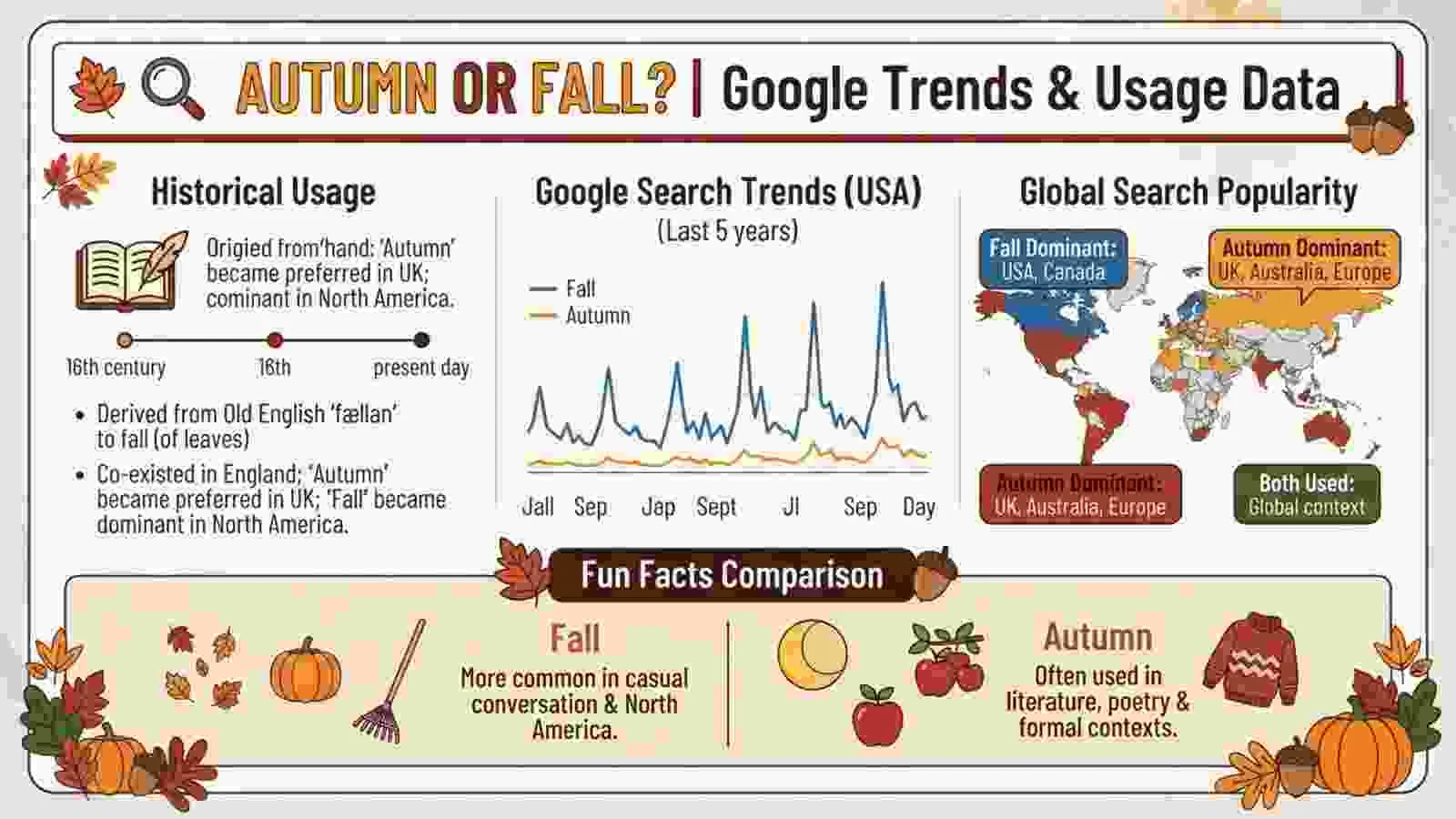
People search for both autumn and fall, but their preferences often depend on location and context.
Which Countries Prefer Autumn?
The word autumn is commonly used in:
- The United Kingdom
- Australia
- New Zealand
- Other regions where British English is common
People in these places often use autumn in daily conversation, school materials, weather reports, and seasonal guides.
Which Countries Prefer Fall?
The word fall is especially common in the United States. It is widely used in searches about seasonal activities, clothing, food, travel, and school schedules.
For example, searches may include:
- Fall outfits
- Fall activities
- Fall recipes
- Fall travel ideas
- Fall semester dates
What About Google Trends?
Google Trends can help compare search interest for autumn and fall across countries and time periods. However, search interest is not the same as total search volume. Results can change based on the selected region, date range, and search category.
No live Google Trends figures are provided here, so exact rankings or percentages should not be assumed.
For SEO, consider using the word your target audience is most likely to search for. You can compare both terms in Google Trends and review keyword data for your target country before choosing your primary keyword.
Autumn vs Fall: Comparison Table
| Point | Autumn | Fall |
| Meaning | Season between summer and winter | Season between summer and winter |
| Word history | From Latin through Old French | Linked to falling leaves |
| Main region | UK and many other countries | United States |
| Everyday use | Common in British English | Common in American English |
| Formal writing | Correct | Also correct |
| Common phrase | In autumn | In the fall |
| Seasonal clothing | Autumn clothes | Fall clothes |
| Correct spelling | Autumn | Fall |
The key difference is regional preference. The two words describe the same season.
FAQs About Autumn or Fall
1. Is Autumn or Fall Correct?
Both are correct. Autumn is more common in British English, while fall is more common in American English.
2. Why Do Americans Say Fall Instead of Autumn?
The word fall became popular in North America through the older phrase fall of the leaf. It later became the usual everyday name for the season.
3. Do British People Say Fall?
Yes, British people understand and sometimes use fall. However, autumn is the more common term for the season in the UK.
4. Is Autumn More Formal Than Fall?
Autumn can sound more literary or traditional, but both words are acceptable in formal writing. The best choice depends on the audience and context.
5. Which Word Should I Use in an Essay?
Use the word that fits your audience and keep it consistent. For a British audience, choose autumn. For an American audience, fall is often the more natural choice.
6. Are Autumn and Fall the Same Season?
Yes. Both words refer to the season between summer and winter, when temperatures often drop and many trees lose their leaves.
7. Which Keyword Is Better for SEO: Autumn or Fall?
Choose the term that matches your target country and search intent. Fall is often suitable for US audiences, while autumn is usually better for UK audiences. Check current keyword data before making your final choice.
8. What is the difference between autumn and fall?
There is no difference in meaning — both words name the season between summer and winter. The difference is regional: autumn is the usual word in British English, and fall is the usual word in American English.
9. How do you spell autumn?
Spell it A-U-T-U-M-N: autumn, with a silent n at the end — the n is pronounced in autumnal but not in autumn.
Conclusion
The choice between autumn and fall is simple once you understand regional English. Both words describe the same season, and neither is incorrect. The main difference is where each word is most common.
In the United States, people usually say fall. In the United Kingdom, autumn is the usual choice. Both words can appear in formal writing, everyday speech, emails, and online content.
If you write for a specific country, choose the word that sounds natural to your readers. Use fall for most general American content and autumn for most British content. For an international audience, you can explain both terms when needed.
For SEO, focus on your readers rather than using both words too often. Review regional keyword data, match the search intent, and keep your writing clear.
You do not need to change a correct word just because another country prefers a different one.
In short, autumn and fall mean the same thing, but local habits decide which word people use most often.
Continue Reading:
- Winter This or That: Cozy, Funny, and Festive Choices (for 2026)
- Pink or Blue: Meaning, Differences, and Popular Uses (for 2026)
- Cute or Hot Quiz – Are You Cute, Hot, or Both? (for 2026)
- Cuter or Cutier: Correct Spelling, Meaning, and Usage ( for 2026)
- Selfs or Selves: Meaning, Grammar, and Examples (for 2026)

Mary Roach is an American science writer and bestselling author known for making unusual and complex scientific topics engaging, accessible, and humorous. Her books include Stiff, Packing for Mars, Gulp, and Fuzz.
Author at Simifind.com, sharing clear, informative content designed to help readers understand interesting topics and everyday questions.








1 thought on “Autumn or Fall: Spelling, Meaning, and Everyday Usage (for 2026)”