Have you ever paused mid-sentence because you weren’t sure whether to use “rather” or “whether”?
Hey, I want to share something that happened to me recently about Rather or Whether.
Chatting with a friend when I suddenly saw these terms pop up, and honestly, I wasn’t completely sure how they were different at first.
I kept wondering, “Am I missing something here?” It was a bit confusing, and I didn’t want to use the wrong word in my reply.
So, I decided to look into Rather or Whether and figure out their meanings and contexts.
After understanding the difference, I realized how important it is to know when to use each word to avoid awkward situations in conversations.
I handled it by learning their proper meanings and usage, and now I feel ready whenever I see Rather or Whether again in chats, writing, or social media.
Rather or Whether – Quick Answer
Rather and whether are different words with different meanings.
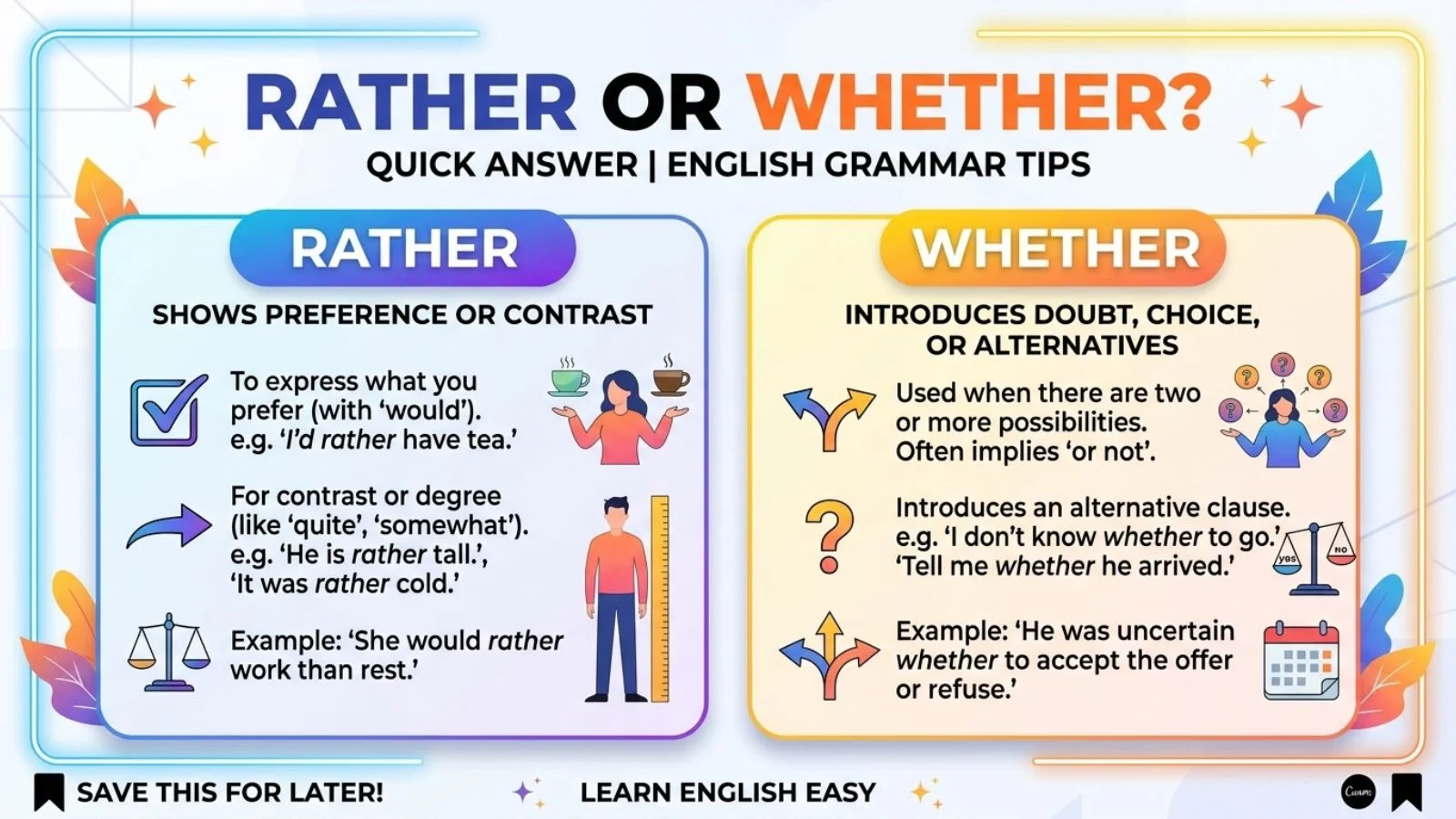
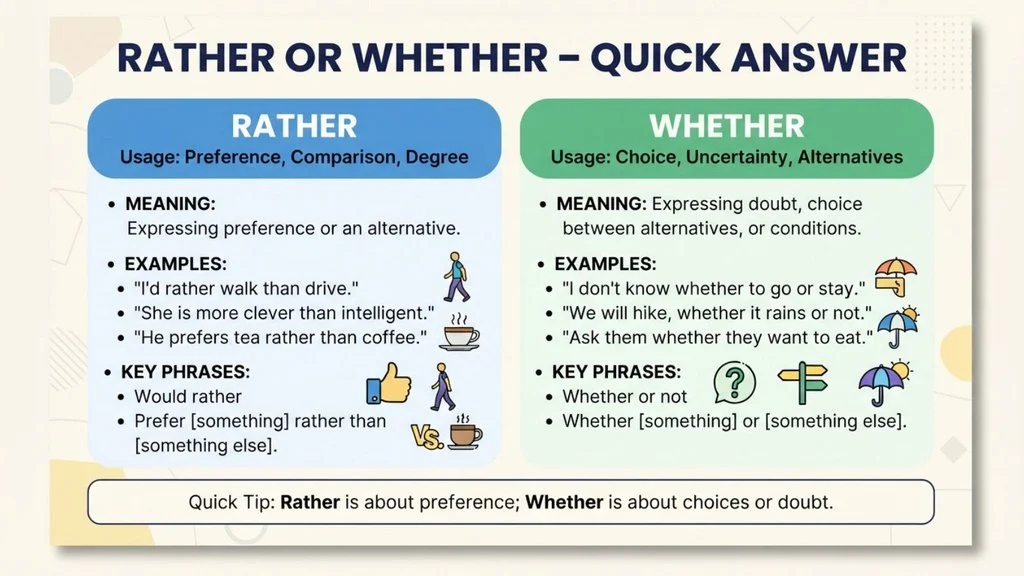
- Rather = preferably, instead, or to some degree.
- Whether = if one thing is true or another thing is true.
Examples with “Rather”
I would rather drink tea than coffee.
Here, rather shows a preference.
She is rather tired today.
Here, rather means “somewhat” or “fairly.”
He chose to walk rather than drive.
Here, rather than means “instead of.”
Examples with “Whether”
I do not know whether he is coming.
Here, whether introduces two possibilities: he may come, or he may not.
Please tell me whether you agree.
We need to decide whether to stay or leave.
Easy Memory Trick
Think of:
Rather = preference
Whether = choice or possibility
So:
I would rather stay home.
But:
I do not know whether I should stay home.
The Origin of Rather or Whether
Although rather and whether look similar, they come from different historical forms and developed different meanings.
Origin of “Rather”
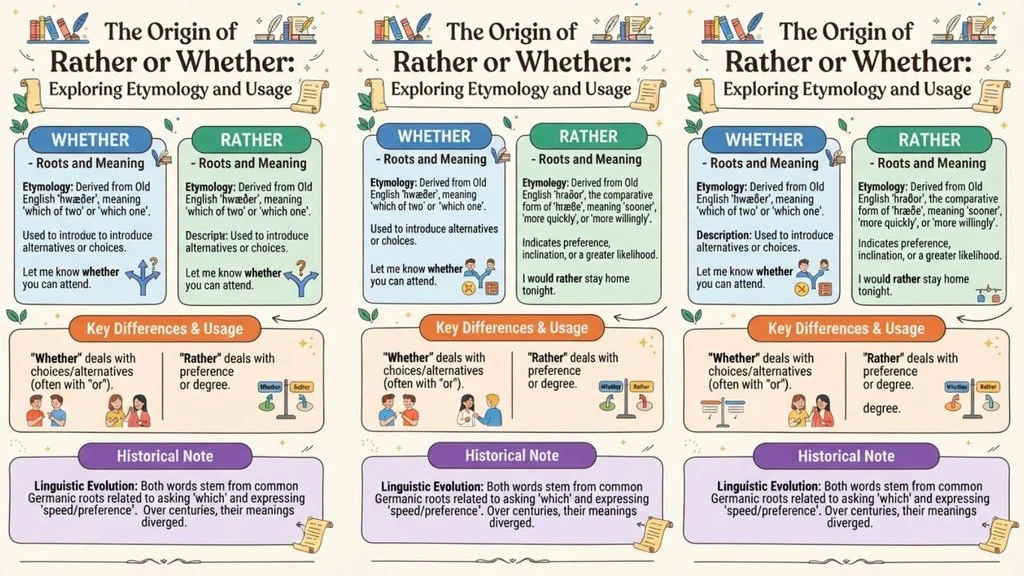
The word rather comes from Old English hrathor, which was related to the idea of being quicker or more readily. Over time, its meaning changed.
It later developed the sense of “more willingly” or “preferably.” This is why we now use it when expressing preference.
For example:
I would rather read a book.
The idea is that reading is preferred over another option.
Modern English also uses rather to mean “fairly” or “somewhat”:
The test was rather difficult.
Origin of “Whether”
Whether comes from Old English hwæther, meaning roughly “which of two” or “which one.”
Its connection with alternatives remains clear in modern English.
For example:
I cannot decide whether to go.
The sentence presents two possibilities:
- go
- not go
Whether is therefore strongly connected with uncertainty, alternatives, and choices.
Why Do They Look Similar?
Both words contain the historical wh/r sound pattern found in several old English question and choice words. However, their meanings developed separately.
Today, their similar appearance can cause spelling mistakes, especially when people hear the words rather than see them in writing.
British English vs American English Spelling
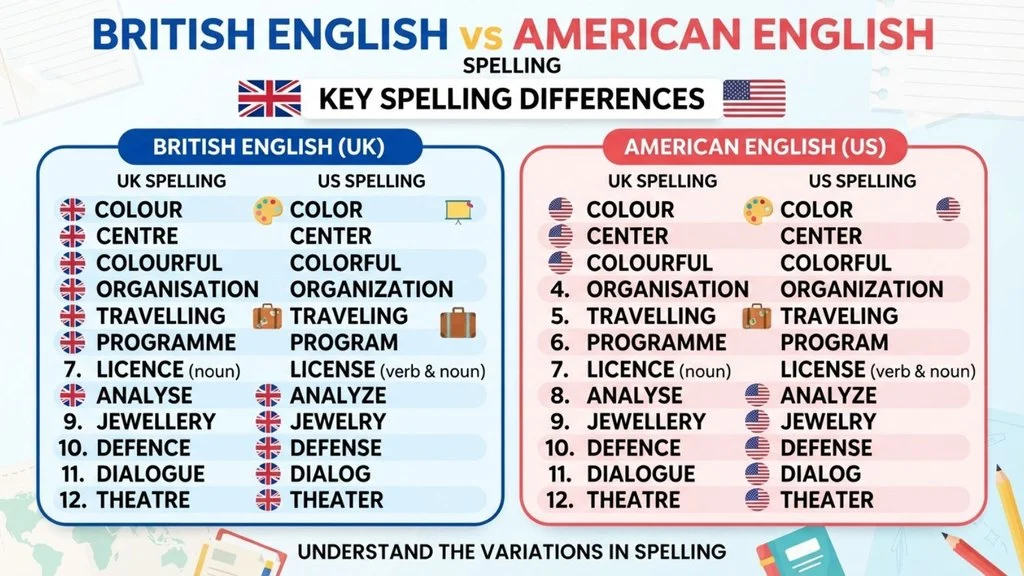
There is no major British-versus-American spelling difference between rather and whether.
Both forms are standard:
| Word | British English | American English | Meaning |
| Rather | rather | rather | Preference, instead, degree |
| Whether | whether | whether | Choice or possibility |
| Rather than | rather than | rather than | Instead of |
| Whether or not | whether or not | whether or not | Regardless of the possibility |
Unlike words such as colour/color or centre/center, these words do not normally change spelling between British and American English.
Examples in British English
I would rather walk than take the bus.
I am unsure whether she knows.
Examples in American English
I would rather walk than take the bus.
I am unsure whether she knows.
The spelling stays the same.
Comparison Table
| Feature | Rather | Whether |
| Main function | Shows preference, contrast, or degree | Shows alternatives or uncertainty |
| Common phrase | rather than | whether or not |
| Can show preference? | Yes | No |
| Can introduce alternatives? | Sometimes through “rather than” | Yes |
| British spelling | Rather | Whether |
| American spelling | Rather | Whether |
| Common confusion | Mistaken for “whether” | Mistaken for “rather” |
Which Spelling Should Use Rather or Whether ?
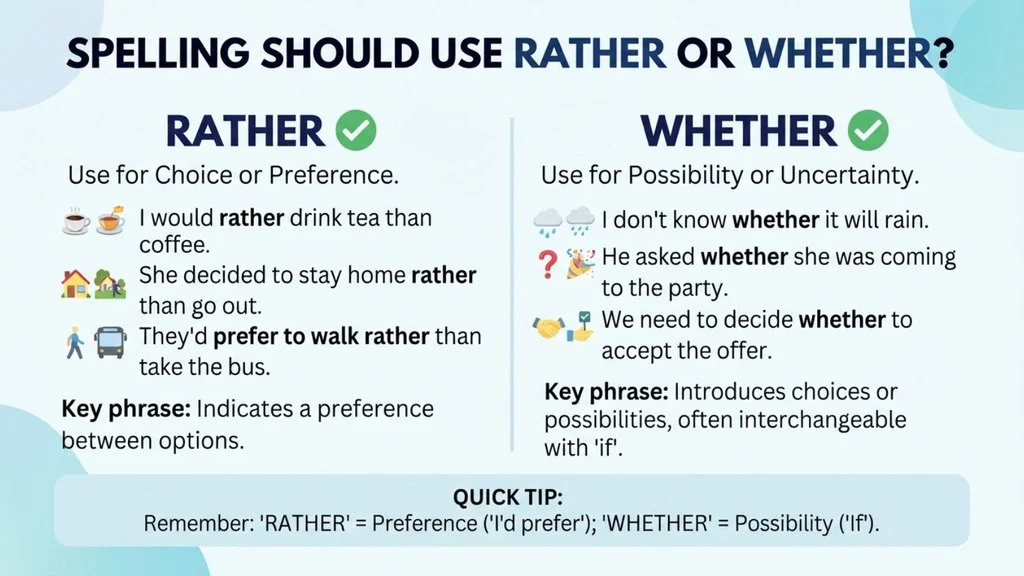
The correct word depends on your meaning, not your country.
Use “Rather” for Preference
Use rather when you want to say that you prefer one thing.
I would rather stay here.
She would rather study at home.
You can also use:
rather than
For example:
He walked rather than took the car.
Use “Whether” for Possibilities
Use whether when you are considering alternatives or asking about uncertainty.
I don’t know whether he will attend.
We need to decide whether to continue.
For US Writers
American English uses rather and whether in the same basic ways as British English.
For UK and Commonwealth Writers
British and Commonwealth English also follow the same basic distinction.
For Global English
If you write for an international audience, focus on the meaning of the sentence. There is no need to change either spelling for British or American readers.
Common Mistakes with Rather or Whether
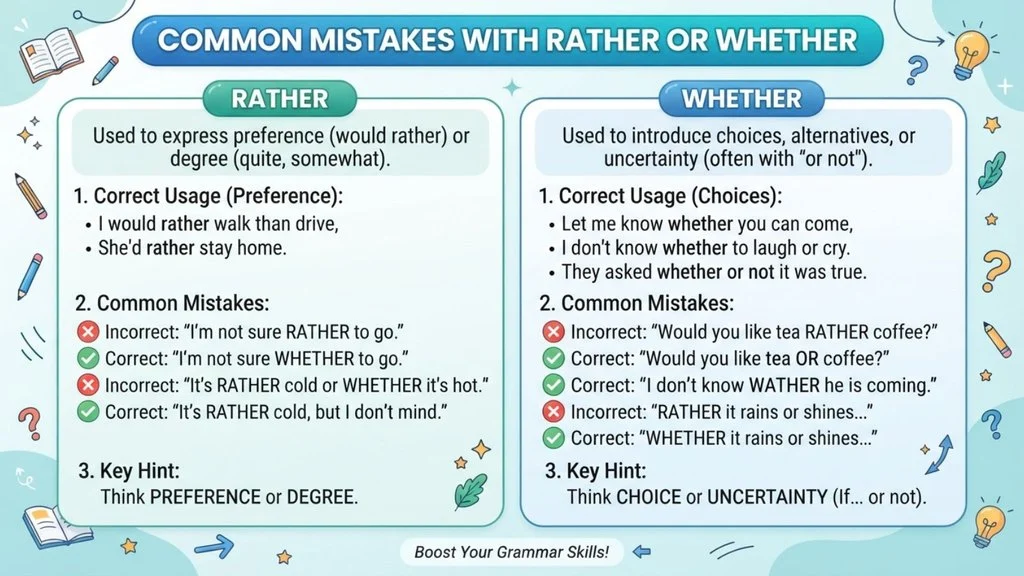
Because the words sound somewhat alike, writers sometimes use one when they need the other.
Mistake 1: Using “Whether” for Preference
❌ I would whether stay home.
✅ I would rather stay home.
Why? “Rather” expresses preference.
Mistake 2: Using “Rather” for Uncertainty
❌ I don’t know rather she will come.
✅ I don’t know whether she will come.
Why? “Whether” introduces uncertainty or alternatives.
Mistake 3: Confusing “Rather Than” and “Whether”
These expressions have different functions.
I would rather walk than drive.
I don’t know whether to walk or drive.
The first sentence expresses a preference.
The second presents a choice or uncertainty.
Mistake 4: Spelling “Whether” as “Wether”
Wether is a different word. It refers to a castrated male sheep.
So:
❌ I don’t know wether she will come.
✅ I don’t know whether she will come.
Mistake 5: Using “Rather” When “Whether” Is Needed
❌ Please tell me rather you agree.
✅ Please tell me whether you agree.
Rather or Whether in Everyday Examples
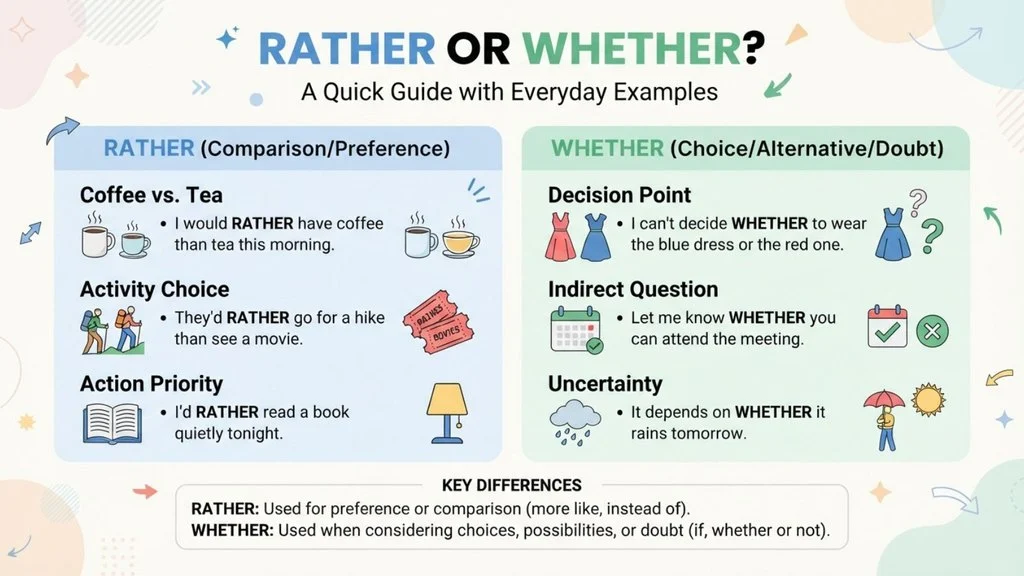
Understanding these words becomes easier when you see them in real situations.
In Emails
Please let me know whether you are available tomorrow.
I would rather discuss this issue by email.
In News Writing
Officials have not confirmed whether the event will continue.
The company would rather delay the launch than release an unfinished product.
In Social Media
Would you rather travel alone or with friends?
I don’t know whether I should post this.
In Formal Writing
The study examines whether the policy achieved its intended results.
The author would rather focus on long-term effects.
In Everyday Conversation
I’d rather have tea.
I don’t know whether they are coming.
In Academic Writing
Researchers examined whether the treatment produced measurable results.
The paper focuses on prevention rather than treatment.
Rather or Whether – Google Trends & Usage Data
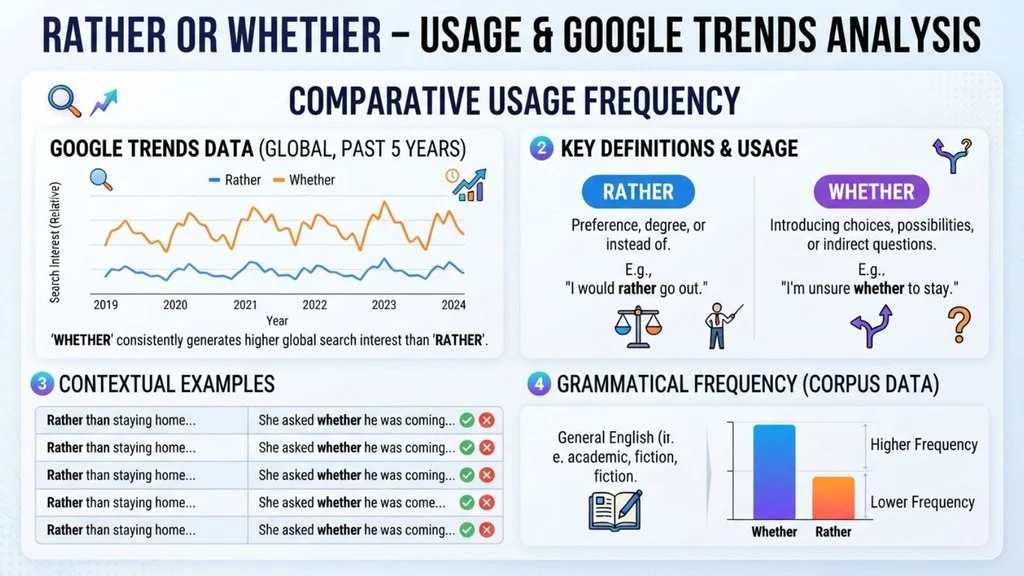
Search interest in “rather or whether” usually comes from people who are unsure about spelling or grammar. The two words themselves are much more common than the comparison phrase.
There is also an important difference in search intent.
People searching for rather may be looking for:
- meaning
- synonyms
- “would rather” grammar
- “rather than” usage
- preference expressions
People searching for whether may be looking for:
- whether vs if
- whether or not
- grammar rules
- sentence examples
- correct spelling
Search behavior can also vary by country, education level, and writing context. However, there is no British-American spelling split for these two words.
For current Google Trends comparisons, search the individual terms and the phrase “rather or whether” separately. This gives a clearer picture because comparing two very common grammar words can produce misleading results if the search terms are interpreted differently.
Usage Comparison
| Search Term | Typical Search Intent |
| rather | Meaning and grammar |
| whether | Meaning and grammar |
| rather than | Grammar and sentence construction |
| whether or not | Grammar and alternatives |
| rather or whether | Spelling and word confusion |
| rather vs whether | Meaning and usage comparison |
Rather vs Whether: Side-by-Side Comparison
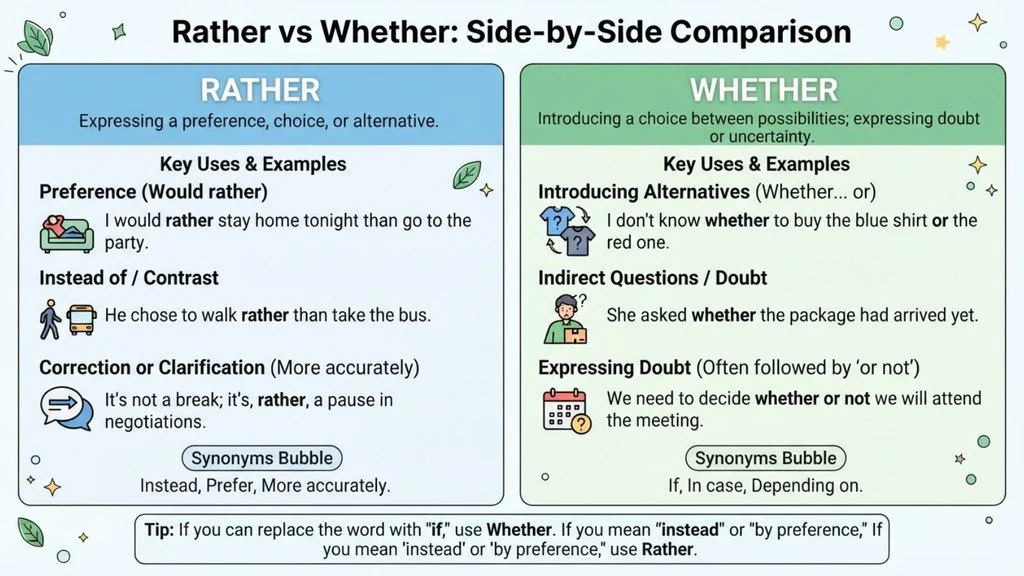
| Feature | Rather | Whether |
| Word type | Adverb | Conjunction |
| Main meaning | Preferably, instead, somewhat | If, or which of alternatives |
| Shows preference | Yes | No |
| Shows uncertainty | No | Yes |
| Common construction | would rather | whether…or |
| Common phrase | rather than | whether or not |
| Example | I would rather leave. | I don’t know whether to leave. |
| Spelling in US English | Rather | Whether |
| Spelling in UK English | Rather | Whether |
FAQs About Rather or Whether
1. What is the difference between rather and whether?
Rather commonly expresses preference, degree, or contrast. Whether introduces alternatives or uncertainty.
2. Is it “rather or whether”?
Both words are correct, but they cannot normally replace each other. The correct choice depends on the meaning of the sentence.
3. Is “I would rather” correct?
Yes. Would rather is a common structure used to express preference.
I would rather stay home.
4. Is “I don’t know whether” correct?
Yes. Whether is commonly used after expressions of uncertainty.
I don’t know whether he is coming.
5. Is “rather than” correct English?
Yes. Rather than is used to express an alternative or preference.
She walked rather than drove.
6. Is “whether or not” correct?
Yes. Whether or not means that something is true regardless of the outcome.
I will go whether or not you come.
7. Are rather and whether spelled differently in British and American English?
No. Both words normally have the same spelling in British and American English.
Conclusion
The difference between rather or whether becomes easy once you focus on meaning. Rather is mainly used for preference, contrast, or degree.
Whether is used for alternatives, choices, and uncertainty. They may look similar, but they perform different jobs in a sentence.
Use rather when you want to express a preference: “I would rather stay home.” Use whether when you are talking about uncertainty or two possible outcomes: “I don’t know whether she will come.”
The phrase rather than is also common when comparing preferred alternatives, while whether or not is used to show that something applies regardless of the outcome.
There is no important British-American spelling difference between these words. The key is choosing the word that matches your intended meaning.
If you remember rather = preference and whether = possibility or choice, you can avoid most common mistakes in emails, essays, conversations, and formal writing.

Here’s a concise 2-line author bio suitable for Simifind.com:
James Dashner is an American bestselling author best known for The Maze Runner series and other popular young-adult fiction.
On Simifind.com, he shares clear, engaging insights and helpful content for readers interested in books, writing, and popular literature.