Have you ever wondered why some flowers bloom for only one season while others return year after year?
The answer often comes down to two plant types: annual and perennial. These words are common in gardening, farming, and plant care. However, many people confuse their meanings.
When searching for annual or perennial, readers want to know how these plants grow, how long they live, and which type is better for their gardens.
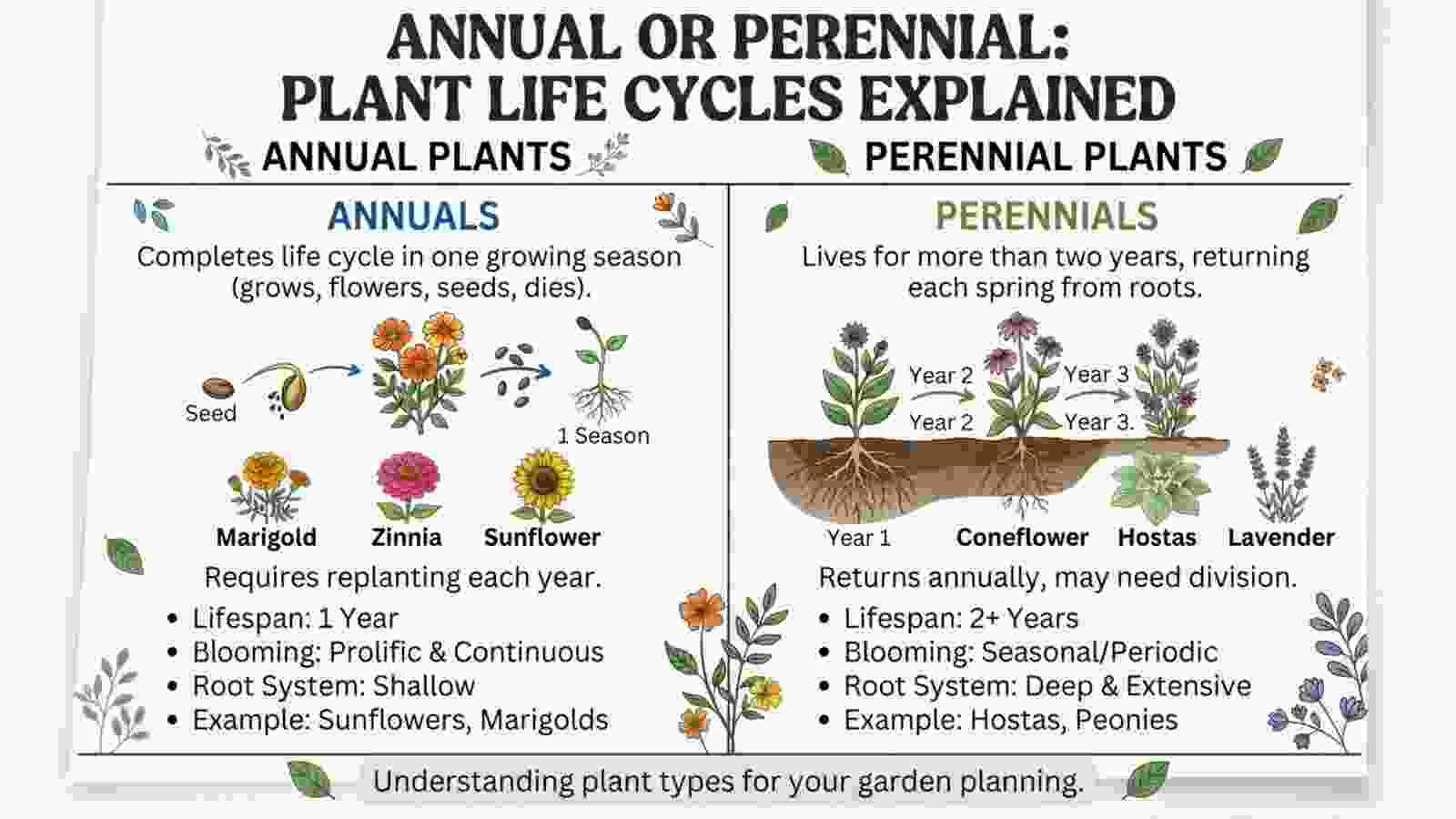
Both types have unique features. Annual plants complete their life cycle in one growing season. Perennial plants live for more than two years and often grow again after winter.
Understanding the difference can help you choose the right flowers, vegetables, and garden plants. It can also save time, money, and effort.
Whether you are a beginner gardener or someone who loves growing flowers, knowing these terms makes plant care much easier.
In this guide, we will explain their meanings, origins, differences, common mistakes, and everyday examples.
Annual or Perennial – Quick Answer
Annual and perennial describe how long a plant lives.
- Annual: A plant that grows, flowers, produces seeds, and dies within one growing season.
- Perennial: A plant that lives for more than two years and grows again in later seasons.
For example, sunflowers and marigolds are common annual plants. Roses, lavender, and peonies are examples of perennial plants.
The main difference is their life span, not their spelling or pronunciation.
The Origin of Annual and Perennial
The words annual and perennial come from Latin roots.
Annual comes from the Latin word annus, which means year. It describes something that happens once a year or lasts for one year.
Perennial comes from the Latin word perennis. It combines the ideas of lasting and continuing through the years. This meaning fits plants that live for many growing seasons.
Over time, these words became common in gardening, agriculture, science, and everyday English.
Unlike spelling pairs such as American and British English variations, annual and perennial are two different words. They have different meanings and cannot replace each other.
British English vs American English Spelling
There is no spelling difference between annual and perennial in British and American English.
Both countries use the same spelling. The meanings also remain the same.
| Word | American English | British English | Meaning |
| Annual | Annual | Annual | Lives for one growing season |
| Perennial | Perennial | Perennial | Lives for more than two years |
| Annual flowers | Annual flowers | Annual flowers | Flowers that grow for one season |
| Perennial plants | Perennial plants | Perennial plants | Plants that return in later seasons |
Examples in American English
- I planted annual flowers in my garden.
- Roses are popular perennial plants.
- Annual plants need to be replaced each year.
Examples in British English
- The garden has many annual flowers.
- Lavender is a useful perennial herb.
- Perennial plants can grow for several years.
The spelling does not change based on location. Only the plant type and its life cycle matter.
Which Spelling Should You Use?
You can use both words in the United States, the United Kingdom, Canada, Australia, and other English-speaking countries.
However, your choice depends on the plant you want to describe.
For US Readers: Use annual for plants that complete their life cycle in one growing season. Use perennial for plants that return in later years.
For UK and Commonwealth Readers: Follow the same meanings and spellings. Both terms are standard in gardening and botanical writing.
For Global Readers: Use these words when discussing plant life cycles, garden design, flowers, and farming.
Remember that annual and perennial are not alternative spellings. They describe two different plant groups.
Common Mistakes with Annual or Perennial
Many beginners make mistakes when using these terms. Here are some common errors and their corrections.
| Common Mistake | Correct Usage |
| Calling every flower annual | Flowers can be annual, perennial, or biennial |
| Saying annual plants return every year | Annual plants complete their life cycle in one season |
| Calling roses annual plants | Most garden roses are perennial |
| Thinking perennial means evergreen | Perennials can lose their leaves in winter |
| Using both words as synonyms | They describe different life cycles |
| Thinking all perennial plants live forever | Perennials have different life spans |
Annual vs Perennial vs Biennial
A third term is also important: biennial.
- Annual plants complete their life cycle in one growing season.
- Biennial plants usually complete their life cycle over two growing seasons.
- Perennial plants live for more than two years.
Understanding all three terms helps you make better gardening choices.
Annual or Perennial in Everyday Examples
These words appear in gardening, farming, emails, news reports, and educational writing.
1. In Emails
- Please order annual flowers for the front garden.
- We need more perennial plants for the garden beds.
2. In News
- Garden experts recommend annual flowers for seasonal color.
- Perennial plants are popular because they can return each year.
3. On Social Media
- My annual flowers look beautiful this summer!
- I love growing perennial plants in my backyard.
4. In Formal Writing
- Annual plants complete their life cycle within one growing season.
- Perennial plants survive for multiple growing seasons under suitable conditions.
5. In Gardening
- Marigolds are popular annual flowers.
- Peonies are well-known perennial flowers.
- Many vegetables are grown as annual crops.
These examples show how both words fit different situations.
Annual or Perennial – Google Trends and Usage Data
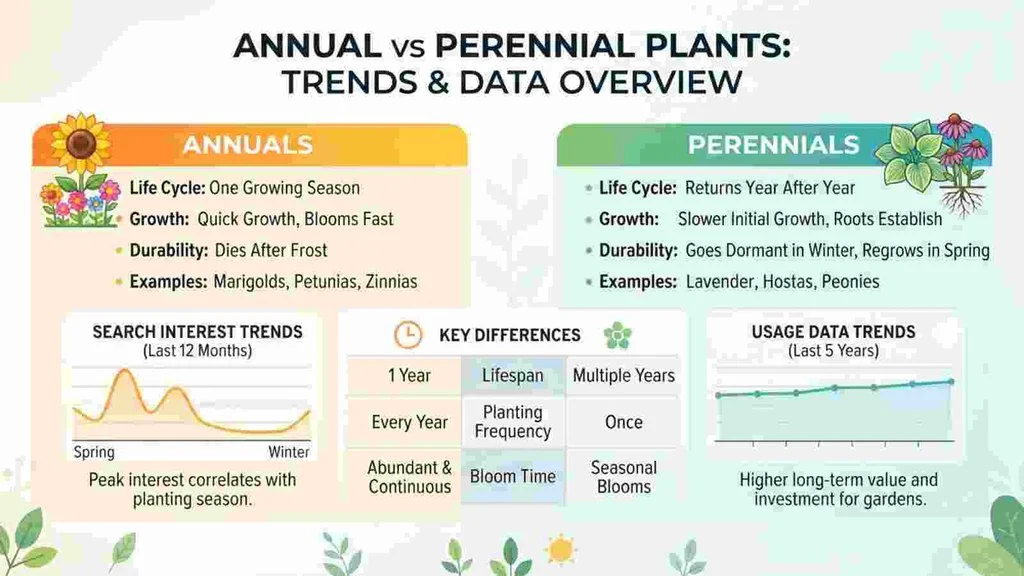
The terms annual and perennial appear in different search contexts.
Annual is commonly used in searches about:
- Annual flowers
- Annual plants
- Annual garden plants
- Annual vegetables
- Annual planting guides
Perennial is commonly used in searches about:
- Perennial flowers
- Perennial plants
- Perennial garden ideas
- Perennial herbs
- Perennial plant care
The popularity of these terms can change by country, season, and gardening interest.
In the United States, both terms are useful in home gardening and landscaping. In the United Kingdom, Australia, and Canada, they also appear in gardening guides and plant-care discussions.
However, exact country rankings and search volumes require current Google Trends or keyword research data. No verified live figures are included here.
Comparison Table: Annual vs Perennial
| Feature | Annual | Perennial |
| Life span | One growing season | More than two years |
| Growth cycle | Completes in one season | Returns over several seasons |
| Flowering | Often blooms for one season | May bloom every year |
| Replanting | Usually needed each year | Usually not needed every year |
| Maintenance | Often needs seasonal replacement | Depends on the plant |
| Examples | Marigold, sunflower | Rose, lavender |
| Best use | Seasonal garden color | Long-term garden design |
FAQs About Annual or Perennial
1. What is the main difference between annual and perennial plants?
Annual plants complete their life cycle in one growing season. Perennial plants live for more than two years and can grow again in later seasons.
2. Are roses annual or perennial?
Most garden roses are perennial plants. They can survive for several years with proper care.
3. Do annual flowers come back every year?
No. Most annual flowers die after completing their life cycle. You usually need to plant new ones the following season.
4. Do perennial plants survive winter?
Many perennial plants survive winter through their roots, bulbs, or underground stems. However, their ability to survive depends on the species and climate.
5. Is lavender an annual or perennial plant?
Lavender is generally a perennial plant. It can return each year when grown in suitable conditions.
6. Which is better for a garden, annual or perennial?
Both are useful. Annuals provide seasonal color, while perennials are useful for long-term garden designs. Many gardeners grow both.
7. What is a biennial plant?
A biennial plant usually completes its life cycle over two growing seasons. It grows leaves and roots in the first season and flowers and produces seeds in the second.
Conclusion
Understanding annual or perennial plants is important for anyone interested in gardening.
Both types have different life cycles, growing habits, and uses. Annual plants complete their life cycle in one growing season.
They are a good choice when you want fresh flowers and seasonal color. Perennial plants live for more than two years and can return in later seasons. They are useful for gardens that need long-term beauty.
The words annual and perennial have the same spelling in American and British English. They are not spelling variations but two different terms with separate meanings. You can use them in gardening, farming, science, and everyday writing.
Before choosing plants for your garden, consider your climate, available space, and care needs.
You can also combine annual and perennial flowers to create a colorful and lasting garden. Knowing the difference will help you make better choices and enjoy healthier plants.

Here’s a concise 2-line author bio suitable for Simifind.com:
James Dashner is an American bestselling author best known for The Maze Runner series and other popular young-adult fiction.
On Simifind.com, he shares clear, engaging insights and helpful content for readers interested in books, writing, and popular literature.