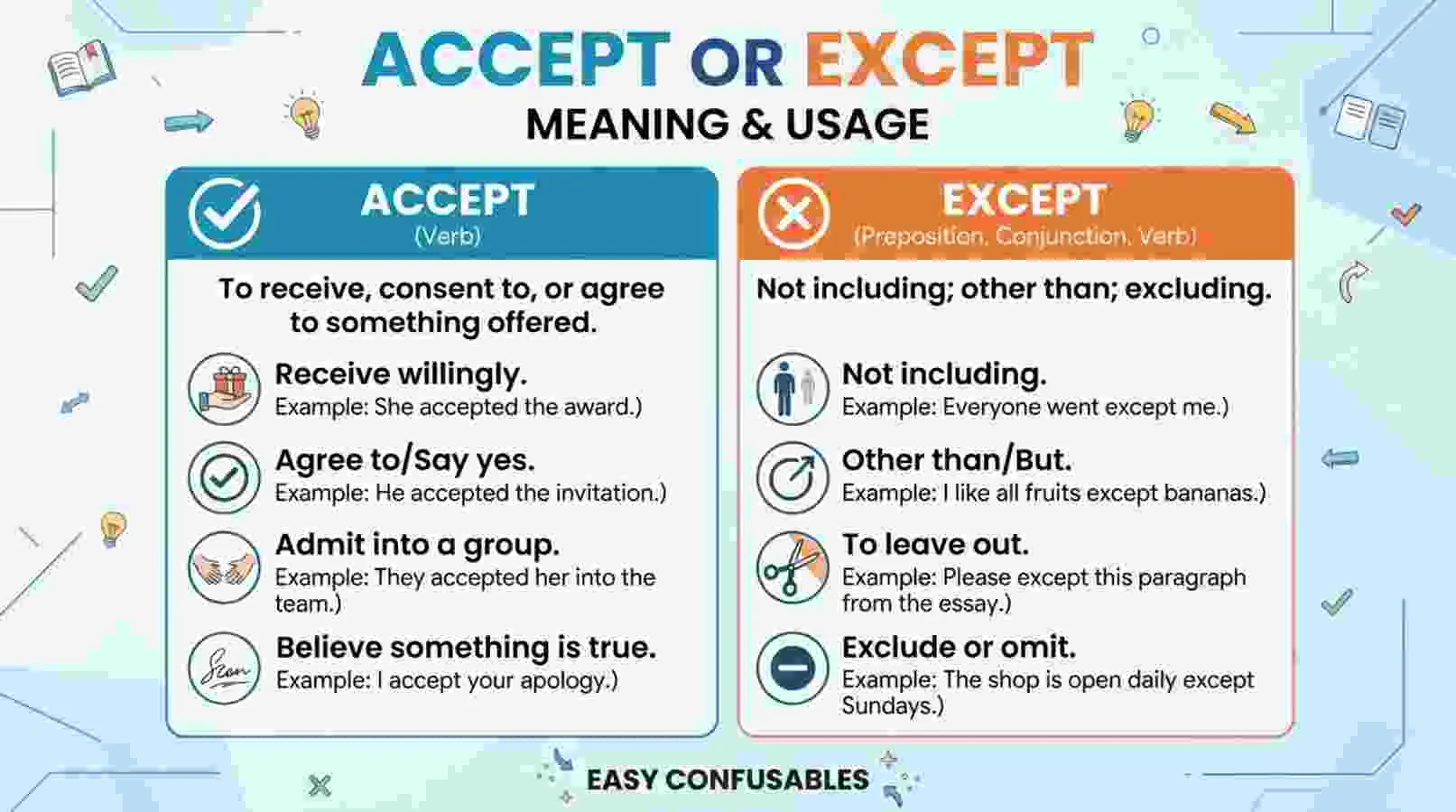
Accept means to receive or agree to something — ‘I accept your apology.’ Except means to exclude or leave out — ‘Everyone came except John.’ Accept is about receiving; except is about leaving out.
Have you ever stopped while writing an email because you were unsure whether to use accept or except? You are not alone.
These two words look and sound almost the same, but they have very different meanings. Using the wrong one can change the meaning of your sentence.
Many readers look up accept or except because they want to improve their spelling, grammar, and everyday English.
Students, teachers, writers, and professionals may all face this common problem. The good news is that learning the difference is easy.
Accept is a verb. It means to receive, agree to, or say yes to something. Except is usually a preposition. It means not including someone or something.
For example, you can accept an invitation, but you can invite everyone except John.
In this guide, you will learn their meanings, origins, spelling rules, and correct usage. You will also find simple examples, common mistakes, and helpful tips to remember the difference.
Accept or Except Quick Answer
Accept means to receive or agree to something. Except means to leave something or someone out.
Although these words sound similar, they are not interchangeable.
Examples:
- I accept your invitation.
- Everyone came except Sarah.
- She will accept the job offer.
- We eat all fruits except bananas.
A simple way to remember:
- Accept = Agree or receive.
- Except = Exclude or leave out.
| Word | Meaning | Part of Speech | Example |
| Accept | To receive or agree | Verb | I accept your offer. |
| Except | Not including | Preposition / Conjunction | Everyone came except Ali. |
The Origin of Accept or Except
The words accept and except have Latin roots. Both come from the Latin verb capere, which means “to take.”
However, their prefixes give them different meanings.
Origin of Accept
The word accept comes from the Latin acceptare, which means to receive willingly or take something. It entered English through Old French. Over time, it developed the meaning of receiving, agreeing, or approving something.
Today, people use accept when they agree to an offer, receive a gift, or recognize something as true.
Origin of Except
The word except comes from the Latin excipere. It combines ex, meaning “out,” and capere, meaning “to take.” Its original meaning was to take out or exclude.
Today, except is used when someone or something is not included in a group.
Both words share a historical root, but their meanings have developed in different ways.
British English vs American English Spelling
There is no spelling difference between accept and except in British and American English.
Both countries use the same spelling for these words. Their meanings and basic grammar rules also remain the same.
However, pronunciation can vary slightly between speakers and accents.
| Feature | British English | American English |
| Accept | Accept | Accept |
| Except | Except | Except |
| Meaning of Accept | Receive or agree | Receive or agree |
| Meaning of Except | Not including | Not including |
| Spelling | Same | Same |
| Grammar | Same | Same |
Examples in British English:
- I accept your kind offer.
- Everyone attended except Peter.
Examples in American English:
- She accepts the new job.
- All students passed except Mark.
The main point is simple: neither word changes its spelling based on the country.
Which Spelling Should You Use?
Choosing between accept and except depends on the meaning of your sentence, not your location.
Here is how to use both words correctly for different audiences.
For American English Readers
Use accept when you mean to receive or agree. Use except when you want to exclude something.
Example: I accept the invitation, but everyone except John must arrive early.
For British English Readers
Follow the same spelling and grammar rules. British English does not use a different version of these words.
Example: She accepted the offer, except for the changes to the schedule.
For Commonwealth Countries
Countries such as Pakistan, India, Australia, and Canada use both words with the same spellings and meanings.
Example: All students can join the event except those who have not registered.
For Global English Writing
If you write for an international audience, choose the word that matches your intended meaning. Keep your sentences short and clear.
Remember, accept means receive or agree, while except means exclude.
Common Mistakes with Accept or Except
Many English learners confuse these words because they sound alike. However, their meanings are different. Here are some common mistakes and their corrections.
1. Using Except Instead of Accept
Incorrect: I except your apology.
Correct: I accept your apology.
Why? You receive or agree to an apology, so accept is the right word.
2. Using Accept Instead of Except
Incorrect: Everyone came accept Tom.
Correct: Everyone came except Tom.
Why? Tom is not included in the group, so except is correct.
3. Confusing Them in Emails
Incorrect: Please except my invitation.
Correct: Please accept my invitation.
Why? You want someone to agree to your invitation.
4. Using Both Words Without Checking Meaning
Incorrect: I will except the rules.
Correct: I will accept the rules.
Why? You agree to follow the rules.
Easy Tip: Before using either word, ask yourself:
- Does the sentence mean receive or agree? Use accept.
- Does the sentence mean leave out or exclude? Use except.
Accept or Except in Everyday Examples
Both words appear in daily conversations, schoolwork, emails, social media, and professional writing.
Understanding their correct use can help you communicate clearly.
1. In Emails
- We are happy to accept your application.
- Everyone has received the email except Daniel.
- Please accept our sincere thanks.
2. In News
- The government agreed to accept the new proposal.
- All schools will remain open except those in affected areas.
- The company accepted responsibility for the mistake.
3. On Social Media
- I accept your challenge!
- Everyone liked the picture except my brother.
- I accept that I made a mistake.
4. In Formal Writing
- The committee decided to accept the final report.
- All applications were approved except those with missing documents.
- The university will accept students who meet the requirements.
These examples show that both words are useful in different situations. Always check the meaning before choosing one.
Accept or Except Google Trends & Usage Data

Accept and except are two words many people look up when they want to improve their English spelling and grammar. Both words are common in everyday writing, but they serve different purposes.
You may look up these words when writing emails, completing school assignments, preparing for exams, or learning English as a second language.
Search Interest by Country
Countries where English grammar and vocabulary learning are common areas of interest include:
- United States
- United Kingdom
- Canada
- Australia
- India
- Pakistan
These are relevant English-learning markets, not a verified ranking of search volume for this exact keyword.
Why Do People Search for accept or Except?
- Grammar Learning: Students want to understand the difference between similar words.
- Spelling Practice: English learners want to avoid spelling mistakes.
- Professional Writing: Workers need correct words in emails and reports.
- Exam Preparation: Students study vocabulary for English tests.
- Daily Communication: People want to write clear messages.
Search Context Comparison
| Search Topic | Main Purpose |
| Accept or Except | Understand the difference |
| Accept Meaning | Learn the meaning of accept |
| Except Meaning | Learn the meaning of except |
| Accept in a Sentence | Find correct examples |
| Except in a Sentence | Understand its usage |
| Accept vs Except Grammar | Improve English grammar |
Note: These are related search topics, not measured Google Trends results. Exact popularity and country rankings require a live Google Trends comparison.
Frequently Asked Questions (FAQs)
1. What is the main difference between accept and except?
Accept means to receive or agree to something. Except means to exclude someone or something from a group.
2. Is accept a verb or a noun?
Accept is a verb. It describes an action, such as receiving an offer or agreeing to a decision.
Example: I accept your suggestion.
3. Is except a preposition?
Yes. Except is commonly used as a preposition. It can also work as a conjunction.
Example: Everyone passed except Ali.
4. Can accept and except be used in the same sentence?
Yes. Both words can appear in one sentence when their meanings are correct.
Example: I accept everyone except those who refuse to follow the rules.
5. Is accept or except the correct spelling in British English?
Both are correct spellings in British English. The right choice depends on the meaning of your sentence.
6. How can I remember accept and except easily?
Remember that accept means to agree or receive, while except means to leave out. This simple trick can help you avoid confusion.
7. What is the opposite of accept?
Common opposites of accept include reject, refuse, and decline. The best choice depends on the sentence.
8. What does accept mean?
Accept means to receive or agree to something, for example, “I accept your apology” or “She accepted the job offer.”
9. What does except mean?
Except means to leave out or exclude someone or something, for example “Everyone came except John.”
10. What are some accept vs except examples?
Accept: “I accept your invitation.” Except: “Everyone came except Sarah.”
11. What is the grammar rule for accept and except?
Accept is a verb — use it when you receive or agree to something. Except is usually a preposition — use it when you leave someone or something out. The two words are not interchangeable.
Conclusion
Understanding the difference between accept or except is important for clear English writing. Although these words look and sound similar, they have different meanings and uses.
Accept is a verb that means to receive, agree to, or approve something. You can accept an invitation, accept an apology, or accept a new job.
Except means to leave out or exclude someone or something. For example, everyone can attend the meeting except John.
Both words have the same spelling in British and American English. Their meanings also remain the same across English-speaking countries.
You do not need to learn different spelling rules for the United States, the United Kingdom, or other Commonwealth countries.
The easiest way to remember these words is to connect accept with receiving and except with excluding. Before writing, check what you want to say. This small habit can improve your grammar, spelling, emails, and everyday communication.

Mary Roach is an American science writer and bestselling author known for making unusual and complex scientific topics engaging, accessible, and humorous. Her books include Stiff, Packing for Mars, Gulp, and Fuzz.
Author at Simifind.com, sharing clear, informative content designed to help readers understand interesting topics and everyday questions.