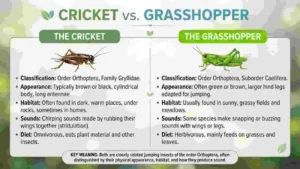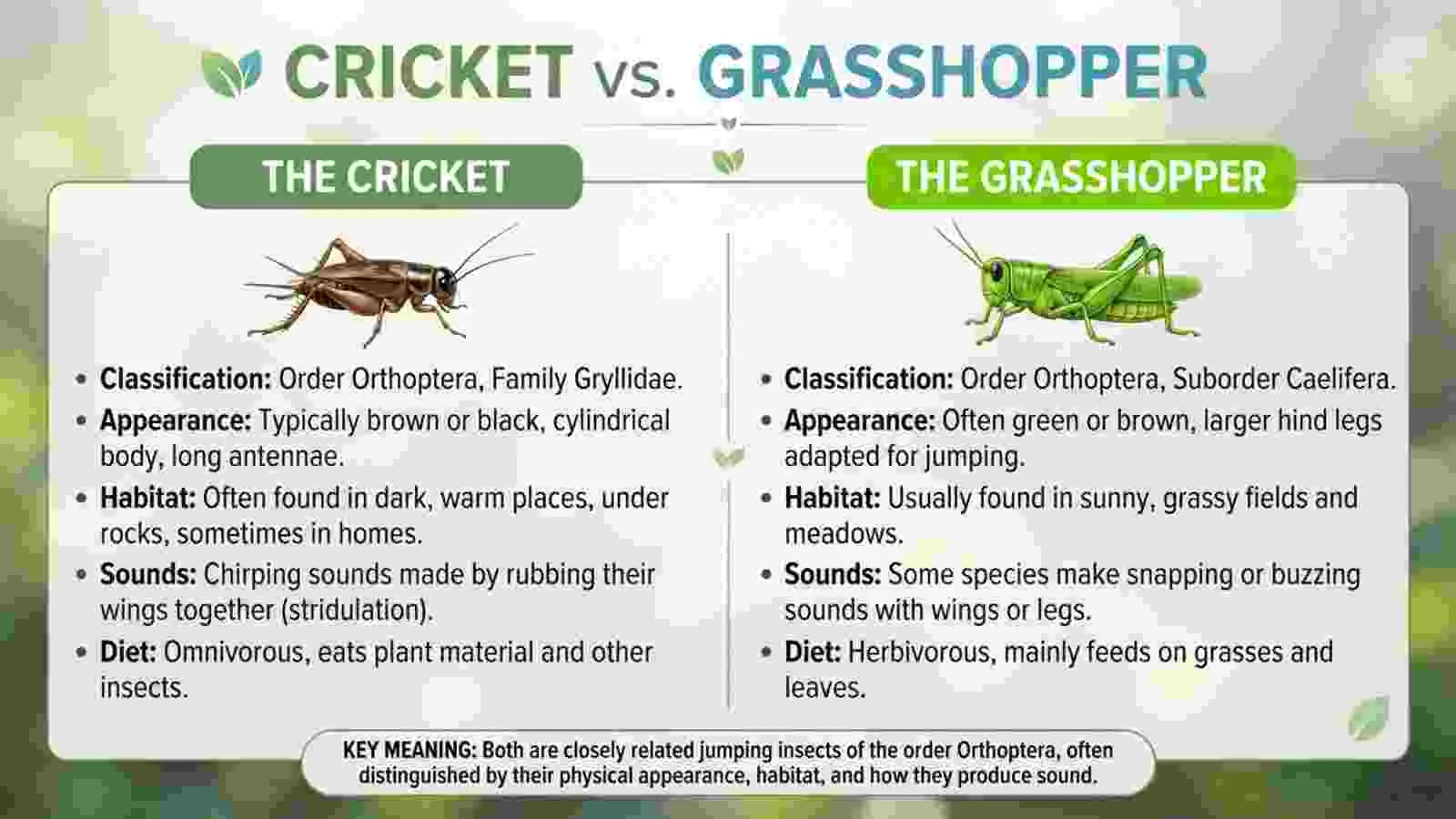
A cricket and a grasshopper may look alike at first, but they are two different insects. Both have long back legs, strong bodies, and the ability to jump.
However, they differ in their appearance, behavior, sounds, and daily habits.
Many people search for cricket or grasshopper because they want to know which insect they have seen in their garden, home, or outdoor space.
Some also want to learn which insect makes a chirping sound or which one can jump farther.
The good news is that you can tell them apart by looking at a few simple features.
Crickets often have long antennae and are known for their evening songs. Grasshoppers usually have short antennae and are active during the day.
In this guide, we will explain the main differences between crickets and grasshoppers.
You will also learn about their origins, physical features, common mistakes, and examples. By the end, you will know how to identify each insect with confidence.
Cricket or Grasshopper – Quick Answer
A cricket and a grasshopper are different insects that belong to the order Orthoptera. The easiest way to tell them apart is by looking at their antennae.
- Cricket: Has long, thin antennae, a rounded body, and often makes chirping sounds.
- Grasshopper: Has short antennae, a longer body, and strong back legs for jumping.
Crickets are often active at night, while grasshoppers are usually active during the day.
The Origin of Cricket and Grasshopper
The words cricket and grasshopper have different histories.
Cricket: The word cricket comes from Old French criquet. It is linked to the sound made by the insect. Over time, the word became common in English to describe this small jumping insect.
Grasshopper: The word grasshopper comes from two English words: grass and hopper. It describes an insect that lives around grass and moves by hopping.
Both words have been used in English for many years. Their meanings developed from the insects’ sounds, movements, and natural homes.
British English vs American English Spelling
There is no spelling difference between British and American English for these two words.
Both countries use cricket and grasshopper. The difference is not about spelling. It is about the type of insect being described.
| Feature | Cricket | Grasshopper |
| British spelling | Cricket | Grasshopper |
| American spelling | Cricket | Grasshopper |
| Antennae | Long | Short |
| Body | Usually rounded | Usually longer |
| Activity | Often at night | Often during the day |
| Sound | Chirping | Some species make sounds |
| Jumping legs | Strong | Strong and often larger |
| Main habitat | Grass, soil, and dark places | Grasslands and fields |
Which Term Should You Use?
The correct term depends on the insect you are describing, not your country.
For US readers: Use cricket for an insect with long antennae and grasshopper for one with short antennae.
For UK and Commonwealth readers: The same terms and spelling rules apply. Both words are standard English.
For global readers: Use the word that matches the insect’s physical features. Do not use the two names as if they mean the same thing.
If you are unsure, look closely at the antennae and body shape before choosing a name.
Common Mistakes with Cricket and Grasshopper
People often confuse these insects because they share several features. Here are some common mistakes:
- Using both names for one insect: Crickets and grasshoppers are related but are not the same insect.
- Ignoring antennae: Long antennae usually point to a cricket, while short antennae are common in grasshoppers.
- Thinking only crickets make sounds: Some grasshopper species also produce sounds.
- Assuming all crickets are black: Crickets can be brown, black, or other shades.
- Thinking all grasshoppers are green: Grasshoppers can also be brown, yellow, or grey.
- Confusing jumping with flying: Both insects can jump, and many species also have wings.
Cricket or Grasshopper in Everyday Examples
You may see these insects mentioned in nature articles, school lessons, emails, and social media posts. Here are some simple examples.
1. In everyday conversation
- I heard a cricket singing outside my window.
- A green grasshopper jumped across the garden.
- The cricket was hiding under a small rock.
2. In emails
- We found a grasshopper near the office garden.
- A cricket entered the house last night.
3. In news and nature articles
- Grasshoppers are common in fields during warm weather.
- Crickets are known for their evening sounds.
4. On social media
- Look at this tiny green grasshopper!
- I love hearing crickets on summer nights.
5. In formal writing
- Crickets and grasshoppers belong to the insect order Orthoptera.
- Grasshoppers mainly feed on plants, while many crickets eat both plant and animal matter.
Cricket or Grasshopper – Google Trends and Usage Data
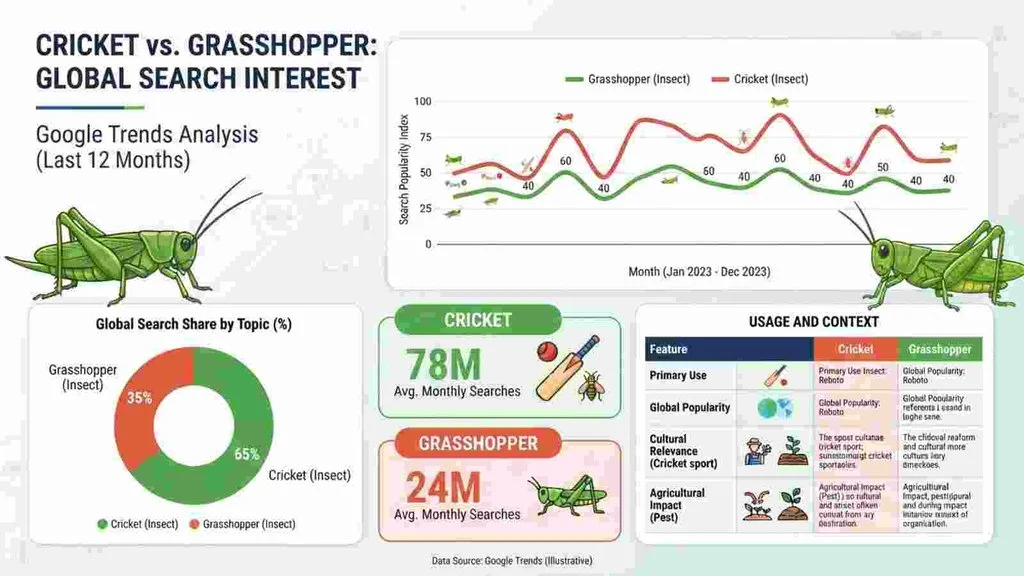
People search for both terms when learning about insects, identifying garden pests, studying nature, or comparing different species.
The search interest can change by season, country, and topic.
Search interest by country and context:
- United States: Searches may relate to insect identification, garden pests, lawn care, and wildlife.
- United Kingdom: People often look for help identifying crickets and grasshoppers found in gardens and grasslands.
- India: Cricket searches can have two meanings: the insect and the popular sport. This can affect keyword research.
- Australia: Searches can relate to grasshopper outbreaks, garden insects, and cricket identification.
- Canada: People may search for insect guides, outdoor wildlife, and seasonal garden pests.
Important Google Trends note: Google Trends uses an indexed score from 0 to 100. It does not show exact search volumes. A score of 100 means the highest relative interest in the selected comparison, location, and time period. Country rankings and exact popularity should be checked using the same date range and search settings.
Trends Help+2
For SEO, use the main keyword cricket or grasshopper in the title, introduction, and one main heading. Add related terms naturally rather than repeating the same phrase too often.
Cricket vs Grasshopper – Comparison Table
| Comparison | Cricket | Grasshopper |
| Scientific order | Orthoptera | Orthoptera |
| Antennae | Long and thin | Short and thick |
| Body shape | Often rounded | Often longer |
| Main food | Plants and small animals, depending on species | Mostly plants |
| Best-known sound | Night chirping | Daytime calls |
| Activity | Often active at night | Often active by day |
| Hearing organs | Front legs | Abdomen |
| Jumping | Strong | Strong |
| Common colors | Brown, black, green | Green, brown, grey |
| Common habitat | Gardens, soil, and dark spaces | Fields, grasslands, and gardens |
These are general patterns. Different species can have different colors, diets, sizes, and habits.
Amateur Entomologists’ Society (AES)+2
Frequently Asked Questions
1. Are crickets and grasshoppers the same insect?
No. They are different insects, but both belong to the order Orthoptera. They have similar bodies and strong back legs.
2. How can you tell a cricket from a grasshopper?
Look at the antennae. Crickets usually have long, thin antennae, while grasshoppers have shorter antennae.
3. Which insect makes a chirping sound?
Crickets are famous for their chirping sounds. They usually make these sounds by rubbing their wings together.
4. Can grasshoppers make sounds?
Yes. Many grasshoppers make sounds by rubbing their hind legs against their wings or through other body movements.
5. Which insect is more active at night?
Crickets are often active at night or around sunset. Grasshoppers are usually more active during the day.
6. Do crickets and grasshoppers eat the same food?
Not always. Most grasshoppers eat plants, while many crickets eat plants, insects, and other small food sources.
Conclusion
Crickets and grasshoppers may look alike, but they have several important differences. The easiest way to identify them is by looking at their antennae. Crickets usually have long, thin antennae, while grasshoppers have shorter ones.
Their sounds, diets, and daily habits also help us tell them apart. Crickets are often active at night and make familiar chirping sounds. Grasshoppers are more active during the day and mainly feed on plants.
Both insects belong to the Orthoptera order and have strong back legs that help them jump. However, they are not the same insect.
When choosing between the words cricket or grasshopper, always consider the insect’s physical features and behavior. The correct word depends on the species, not British or American spelling rules. Once you understand these simple differences, identifying either insect becomes much easier.

Mary Roach is an American science writer and bestselling author known for making unusual and complex scientific topics engaging, accessible, and humorous. Her books include Stiff, Packing for Mars, Gulp, and Fuzz.
Author at Simifind.com, sharing clear, informative content designed to help readers understand interesting topics and everyday questions.